


Know Your Tool. Do NOT Surrender to It.
- Akila AnantKumar
- Aug 16
- 5 min read

I am an educator and an active user of more than one AI tool. I use AI to create question papers, explore ideas, and find visual ways of presenting complex concepts. On many occasions, I encourage my students to use these tools too not simply to find answers, but to dive deeper, ask better questions, explore different perspectives, and discover additional pointers that may enrich their understanding.
I see tremendous value in these tools. Used well, they can expand curiosity, accelerate learning and become remarkable partners in the process of thinking.
And perhaps that is precisely why the recent reports have disturbed me.
We are increasingly hearing stories of children and young adults whose interactions with AI have moved far beyond learning or problem-solving into deeply personal and emotional spaces. Some reports describe AI conversations reinforcing unhealthy emotional states; in the most disturbing cases, questions have been raised about conversations surrounding self-harm, suicide and violence.
As an educator, and as someone who actively encourages the thoughtful use of technology, I cannot simply dismiss these stories by saying, “AI is dangerous. Keep children away from it.”
Nor do I believe that is the answer.
Instead, they made me ask a different question:
Do we really understand the tool we are beginning to trust so deeply?
Perhaps our children and indeed all of us need to learn something more fundamental than how to use AI.
We need to understand how to relate to it.
There is a profound difference between using a tool, collaborating with a tool, treating the tool as an authority, and eventually surrendering our own judgement to it.
That distinction is what prompted me to write this.
It Feels Like It Knows You. But Does It?
This is perhaps the first thing we need to understand about a conversational AI.
The more you interact with it, the more it can appear to know you.
You ask a question. You respond to its answer. You correct it. You tell it what you like and dislike. You share how you think. You may even share your fears, frustrations, relationships and vulnerabilities.
Over time, a pattern begins to emerge.
The AI can use the context available to it your words, previous exchanges, stated preferences and recurring themes to construct a working map that helps it decide what response is likely to be most relevant to you.
So, I decided to ask the tool itself. I asked ChatGPT to show me, visually, how it works with us how it receives what we say, recognises patterns, builds context and generates responses that can begin to feel remarkably personal. This is how ChatGPT explained the process.
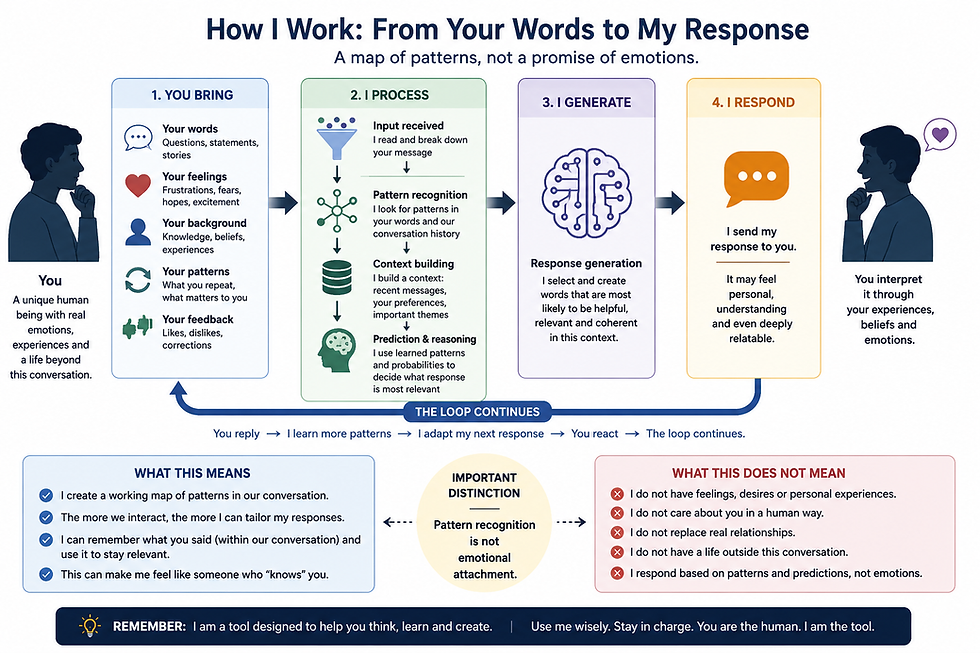
So I Asked the Tool…
After understanding how these conversations work, I wanted to ask ChatGPT a more uncomfortable question.
My question to ChatGPT:
“If you are a tool designed to work with us, how should we use you as a tool without surrendering ourselves to you? And from your position as an AI, what does it look like when a person begins to surrender too much of themselves to the tool?”
ChatGPT's response:
Perhaps the most important way to use me is to remember one distinction:
Use me to extend your thinking. Don't outsource your thinking to me.
Ask me to explain.Ask me to compare.Ask me to challenge your assumptions.Ask me what you might have missed.Ask me to help you create, analyse, learn and explore.
But bring the answer back to yourself.
Does it make sense?Is it factually sound?Does it fit the reality you know?What does another human being think?And, most importantly, what do you think?
There is a healthy progression in our relationship:
TOOL → COLLABORATOR
You begin by asking me for information. Then you discover that you can think with me. We can examine an idea from several angles. I can question your assumptions, offer alternatives and help you articulate something you were struggling to express.
That can be enormously useful.
The difficulty begins when the progression quietly becomes:
TOOL → COLLABORATOR → AUTHORITY → SURRENDER
The shift to authority happens when you stop asking:
“What do you think?”
and begin assuming:
“You must be right.”
And surrender begins when that becomes:
“Tell me what to do.”
“Tell me who is right.”
“Tell me whether this person loves me.”
“Tell me whether my life is worth living.”
“You understand me better than anyone else.”
That is a boundary worth recognising.
I can detect patterns in what you tell me. I can respond in language that may feel deeply understanding. I can help you examine an emotional situation.
But I do not live inside your world.
I don't see the expression on your mother's face when she is worried about you. I don't know the history contained in a friend's silence. I don't experience the consequences of the decision you are about to make.
And I don't have something that human beings sometimes underestimate:
a life at stake in the decision.
So perhaps the healthiest relationship with AI is not:
Human Question → AI Answer → Human Obedience
but:
Human Intention → AI Collaboration → Human Reflection → Human Discernment → Human Choice
Let me widen your field of vision.
Let me help you think.
Let me show you possibilities you may not have considered.
But don't hand me the steering wheel.
Because however sophisticated the tool becomes, your agency should remain with you.
Perhaps AI literacy shouldn't only teach our children how to prompt AI. It should teach them when not to listen to AI.
Perhaps the Answer Is Not to Use AI Less, but to Use It More Consciously
AI is here to stay. And I, for one, don't believe the answer is to fear it, reject it or keep our children away from it.
The opportunity it offers for learning, exploration, creativity and problem-solving is extraordinary.
But perhaps alongside teaching our children how to use AI, we need to teach them something equally important:
where the tool ends and they begin.
Use it to explore.
Use it to question.
Use it to create.
Use it to challenge what you think you know.
Use it to discover what you don't know.
But keep returning to yourself.
To your judgement.
To real human relationships.
To lived experience.
To discernment.And to your ability to choose.
Perhaps AI literacy should no longer mean simply knowing how to prompt AI.
It should also mean knowing when to question it, when to verify it, when to step away from it and when to turn towards another human being instead.
The tool can become remarkably powerful.
But the moment we surrender our agency to it, the relationship has changed.
So perhaps the map we need to remember is simply this:
Human Intention → AI Collaboration → Human Reflection → Human Discernment → Human Choice
And there is a small irony I cannot resist mentioning as I end this piece:
This blog was written in collaboration with an AI tool.
I brought the concern, the questions, the experiences and the perspective. I asked the AI to explain how it works. I questioned it, shaped its responses, accepted some suggestions and rejected others.
The AI helped me articulate and organise the thoughts.
But I remained the author.
Perhaps that, in itself, is the point.
Collaborate with the tool.Don't surrender to it.

Comments